Two acute care hospitals—Kaiser Permanente Vallejo Medical Center on Sereno Drive and Sutter Solano Medical Center on Hospital Drive—as well as a community college center on Columbus Parkway, a health professions graduate campus on Mare Island, and a variety of educational institutions, childcare facilities, and waterfront establishments can be found in Vallejo. Because of this combination, Vallejo residents seek out CPR and First Aid training for a variety of reasons, and the appropriate course is determined by the individual in question.
Residents and employees in Vallejo and neighboring cities like Benicia and American Canyon who require a CPR & First Aid certification course and wish to select the right course the first time are the target audience for this guide. It explains the training’s content, which version is appropriate for jobs in the workplace, childcare, and healthcare, and how to verify prerequisites before registering.
What a CPR & First Aid Certification Course Actually Teaches
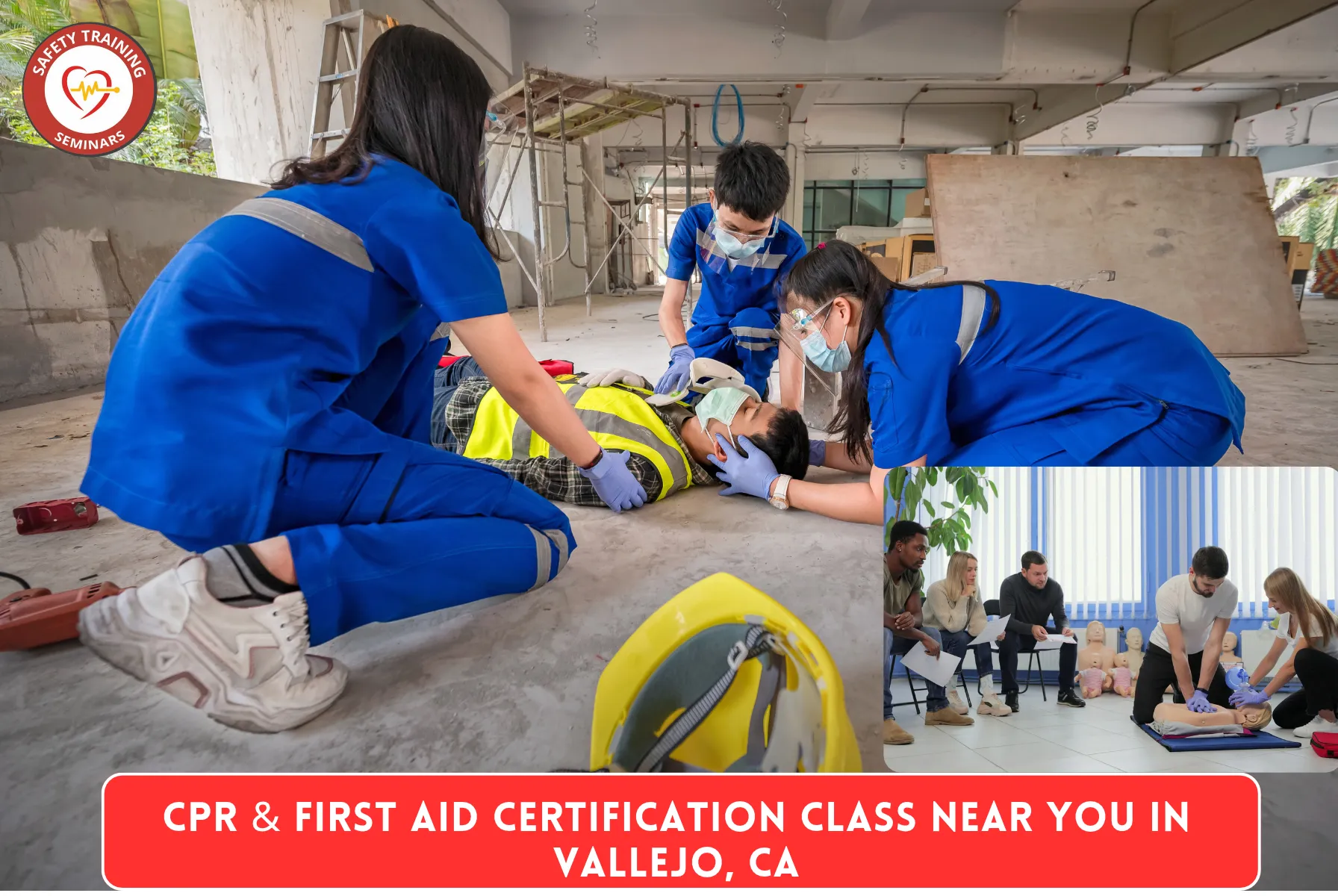
Within the American Heart Association (AHA) course family, the class most people mean by “CPR and First Aid” is Heartsaver® First Aid CPR AED. The AHA designs it for people with little or no medical training who need a course completion card for a job, a regulatory requirement such as OSHA, or another obligation, as well as anyone who simply wants to be prepared for an emergency.
Two terms come up throughout the course:
- CPR (cardiopulmonary resuscitation) is the combination of chest compressions and, when appropriate, rescue breaths used when a person is in cardiac arrest, meaning their heart has stopped pumping blood effectively.
- An AED (automated external defibrillator) is a portable device that analyzes the heart’s rhythm and, if needed, delivers a shock. It gives spoken instructions so that a trained layperson can use it.
A typical Heartsaver First Aid CPR AED course covers:
- First aid basics, including scene safety and when to call 911
- Medical emergencies such as breathing problems, allergic reactions, and the warning signs of heart attack and stroke
- Injury emergencies, including bleeding control, sprains, broken bones, and shock
- Environmental emergencies such as heat- and cold-related illness
- Preventing illness and injury
- Adult CPR, AED use, and choking relief
- Optional child and infant CPR modules, depending on the course path
After completing all course requirements, including a hands-on skills test, participants receive an AHA Heartsaver First Aid CPR AED course completion card that is valid for two years. It is often delivered as an AHA Course Completion eCard. Although people commonly call this “CPR certification,” the card documents that you completed the course. It is not a professional license, and it does not guarantee that a particular employer or program will accept it.
One Search, Three Different Courses
The phrase “CPR & First Aid certification course” covers several kinds of training. Choosing the wrong one is the most common and most costly mistake learners make, because a card that doesn’t match the requirement usually means taking a second class.
| Who you are | Course that usually fits | What sets it apart |
| Office, retail, warehouse, hospitality, fitness, and community learners | AHA Heartsaver First Aid CPR AED | Layperson skills; adult CPR and AED, with child and infant modules available |
| Childcare and preschool staff in California | EMSA-approved Pediatric First Aid and CPR | Built around state childcare training standards and focused on infants and children |
| Nurses, CNAs, medical assistants, EMTs, and clinical students | AHA Basic Life Support (BLS) | Healthcare-provider course covering team-based resuscitation in clinical settings |
For Vallejo workplaces, families, and coaches
If your employer, youth sports league, or volunteer organization asks for “CPR and First Aid,” Heartsaver First Aid CPR AED is usually what they mean. Parents, grandparents, and caregivers may also want the child and infant CPR modules, since the technique differs by age and body size. Confirm whether your requirement calls for adult-only CPR or adult, child, and infant CPR before you enroll.
For childcare and early education programs
California applies a separate standard to childcare providers. Training for childcare providers must follow the state’s Training Standards for Child Care Providers and be approved by the California Emergency Medical Services Authority (EMSA). For first-time providers, the state’s 16-hour requirement includes 4 hours of pediatric First Aid and 4 hours of pediatric CPR/AED, along with preventive health and safety training. A general workplace CPR card does not automatically satisfy childcare training rules, so staff at Vallejo preschools and family childcare homes should confirm that their course is EMSA-approved.
For hospital, clinic, and healthcare student roles
Vallejo’s healthcare workforce is substantial for a city of its size. Kaiser Permanente Vallejo Medical Center operates a 24-hour emergency department, and Sutter Solano Medical Center provides full-service hospital care to Vallejo and surrounding Solano County communities. On Mare Island, Touro University California offers graduate programs in osteopathic medicine, pharmacy, physician assistant studies, nursing, and public health. Solano Community College offers registered nursing, CNA, and EMT programs, and CNA students practice skills at its Vallejo Center.
People in these roles and programs are generally asked for BLS, not a Heartsaver card. BLS is the AHA’s healthcare-provider course. It covers high-quality CPR for adults, children, and infants, team-based response, and the use of a bag-mask device. Some clinical programs and employers may require BLS alone, while others may want BLS plus additional training such as ACLS (Advanced Cardiovascular Life Support) or PALS (Pediatric Advanced Life Support). The safest approach is to request the exact course name in writing from your program coordinator or hiring manager before clinical placements or onboarding.
How California Workplace Rules Shape First Aid Training
CPR and First Aid training is a requirement for many local employers in order to comply with state workplace safety regulations. According to Title 8, Section 3400 of the California Code of Regulations, one or more individuals must be properly trained to administer first aid in situations when there isn’t a hospital, clinic, or infirmary nearby that can treat injured workers. Section 1512 is a related rule that applies to construction sites.
Most firms are not given a set number of trained workers by these requirements. This implies that safety coordinators must determine how many certified responders are required for each shift and location at Vallejo warehouses, hotels, restaurants, maritime companies, and construction sites. Since cardiac arrest is an emergency where every minute without assistance counts, many organizations opt for CPR and AED training in addition to First Aid. This is not legal advice; it is general information. Employers should speak with a trained advisor or Cal/OSHA resources if they have specific issues about compliance.
Before You Register: A Five-Point Checklist
- Get the requirement in writing. Ask for the exact course title, such as Heartsaver First Aid CPR AED, BLS, or EMSA Pediatric First Aid and CPR, and whether an AHA card is expected.
- Match the age groups. Decide whether you need adult-only CPR or adult, child, and infant CPR.
- Choose a format. Some AHA courses can be completed as a full classroom course or as blended learning, with online coursework followed by an in-person skills session. Formats vary by course, so check before you book.
- Plan for renewal. AHA Heartsaver cards are valid for two years. Put the expiration date on your calendar so your training doesn’t lapse during a job search or clinical rotation.
- Know how you’ll receive your card. Ask whether you’ll get an AHA Course Completion eCard by email and how your employer or school wants to see it.
Training at Safety Training Seminars in Downtown Vallejo
Safety Training Seminars teaches American Heart Association courses at its Vallejo training center:
Safety Training Seminars – Vallejo 1006 Marin Street, Suite 107 Vallejo, CA 94590 (707) 215-4213
The Vallejo location offers CPR, First Aid, BLS, ACLS, and PALS courses, and Safety Training Seminars also provides pediatric CPR and First Aid training for California childcare providers. That range lets a warehouse supervisor, a preschool teacher, and a nursing student each find the course that fits their role at the same location. Students from Benicia also use the Vallejo center as a nearby option.
For current class dates, course formats, pricing, and enrollment details, review the CPR & First Aid certification class in Vallejo page before you register.
Vallejo CPR & First Aid Questions, Answered
Is a CPR & First Aid certification the same as a license? No. An AHA course completion card shows that you completed the course and passed its skills test. It is not a professional license, and acceptance depends on your employer, school, or regulating agency.
How long is an AHA Heartsaver First Aid CPR AED card valid? The AHA states that the Heartsaver First Aid CPR AED course completion card is valid for two years.
Will a Heartsaver card work for my nursing or allied health clinical placement? Usually not. Most clinical programs and healthcare employers ask for AHA BLS, which is designed for healthcare providers. Confirm with your program before enrolling.
Does a general CPR & First Aid card meet California childcare requirements? Not automatically. Childcare providers in California generally need EMSA-approved pediatric First Aid and CPR training. Check that the course you choose is EMSA-approved for childcare.
Can I complete part of the course online? Some AHA courses offer blended learning, where you complete online coursework and then attend an in-person skills session. The hands-on skills portion is still required to receive an AHA card. Availability varies by course, so check the course page.
I live in Benicia or American Canyon. Is a Vallejo class practical? For many people, yes. The Marin Street training center serves learners from surrounding communities, including Benicia. Check current schedules to find a session that fits your commute.
Your Next Step
Start by confirming the exact course your job, school, or childcare program requires. Once you know whether you need Heartsaver First Aid CPR AED, BLS, or EMSA pediatric training, choosing a class becomes simple. When you’re ready, review the Vallejo CPR and First Aid certification course options from Safety Training Seminars and reserve a session that fits your schedule.