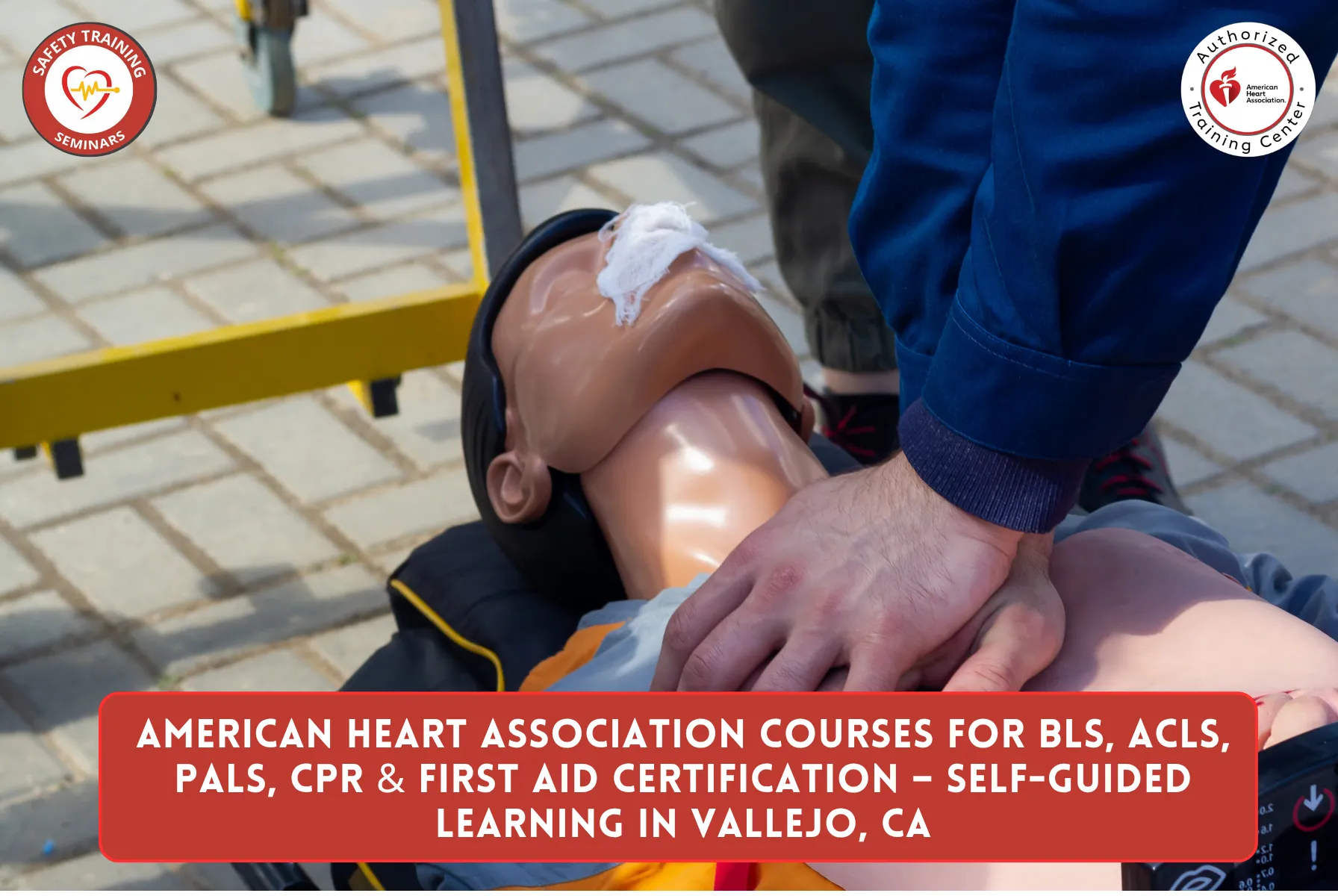
Choosing an American Heart Association course in Vallejo, California, involves more than finding a class with CPR in its name. Healthcare professionals may need BLS, ACLS, or PALS, while teachers, caregivers, workplace employees, and other community members may need CPR, AED, or First Aid training. The delivery format matters, too.
American Heart Association Self-Guided Learning is designed for learners who want to complete the educational portion independently while still completing the applicable hands-on training requirements. That makes it different from an online-only course. Depending on the course, learners can study the cognitive material on their own schedule and then complete hands-on practice and skills verification through the appropriate training process.
For people comparing BLS classes in Vallejo, ACLS or PALS options, or Heartsaver CPR and First Aid training, understanding this distinction can make course selection much easier.
Key Takeaway
AHA Self-Guided Learning combines independent study with the applicable practical skills component rather than eliminating hands-on training. Vallejo learners should select BLS, ACLS, PALS, CPR/AED, or First Aid according to their role and then confirm the exact requirement with their employer, school, or organization.
What Is American Heart Association Self-Guided Learning?
Self-Guided Learning gives students greater control over the educational part of an AHA course. Instead of attending a traditional classroom session for the entire learning experience, the learner completes the cognitive portion independently and then participates in the required hands-on component.
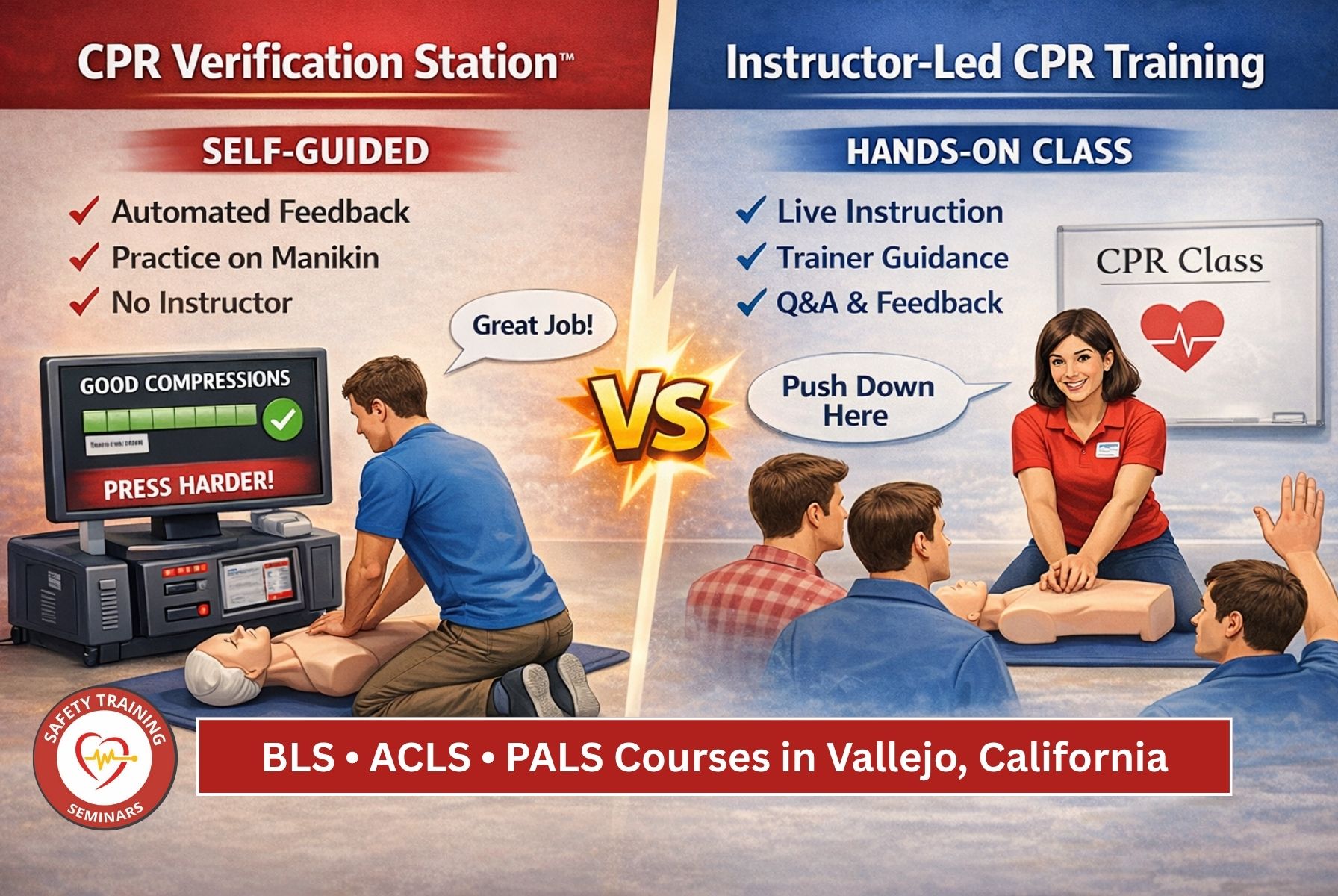
The American Heart Association identifies Self-Guided Learning as a training format that combines independent cognitive learning with hands-on skills practice and verification. For applicable BLS, ACLS, and PALS courses, the hands-on portion can be completed at an approved CPR Verification Station.
The process can generally be thought of as five stages:
- Determine which AHA course matches your requirement.
- Complete the assigned educational material independently.
- Complete the required hands-on skills practice.
- Demonstrate the applicable skills through the required verification or testing process.
- Complete the course and receive the applicable course completion documentation or eCard.
The exact process can differ between courses, so learners should check the details for the specific program they intend to take.
Why isn’t this simply an online course?
An online-only course may consist entirely of digital education. Self-Guided Learning, by contrast, can include an in-person practical component when the course requires hands-on skills. That distinction is particularly important for healthcare workers whose employers or schools require an AHA course that includes skills practice and verification.
BLS Self-Guided Learning in Vallejo
Basic Life Support (BLS) is generally intended for healthcare professionals and appropriate healthcare students. Nurses, nursing students, physicians, EMTs, paramedics, medical assistants, dental professionals, and other healthcare personnel may encounter BLS requirements depending on their position.
BLS is not simply a more advanced version of a public CPR class. Its content is structured for people working in healthcare environments or preparing for roles where healthcare-provider-level basic life support training is relevant.
For someone searching for BLS classes in Vallejo, Self-Guided Learning can be useful when the learner needs flexibility around clinical rotations, coursework, shifts, or other responsibilities. The AHA’s BLS course options include a Self-Guided Learning pathway that combines online cognitive learning with the applicable hands-on skills component.
Before registering, however, confirm that the particular BLS course and format are accepted by the organization requesting your training.
ACLS Training for Healthcare Professionals in Vallejo
Advanced Cardiovascular Life Support (ACLS) is designed for healthcare professionals involved in managing adult cardiovascular emergencies. It is therefore quite different from a general CPR/AED course.
ACLS Self-Guided Learning can allow an appropriate healthcare professional to complete the cognitive portion independently before completing the required practical component. The AHA’s HeartCode Complete ACLS format combines online learning with hands-on skills practice and testing through an approved CPR Verification Station.
A physician, nurse, paramedic, or other healthcare professional in Vallejo should not assume that ACLS is automatically necessary simply because they work in healthcare. Requirements depend on the individual’s position and organization.
It is also important to check whether BLS is separately required. The AHA explains that BLS is not included in ACLS, and ACLS learners are expected to have appropriate BLS proficiency.
PALS Self-Guided Learning in Vallejo
Pediatric Advanced Life Support (PALS) focuses on the assessment and management of pediatric emergencies. It is intended for appropriate healthcare professionals who may be responsible for caring for infants and children during emergency situations.
For healthcare professionals whose work involves pediatric patients, PALS may be the appropriate AHA course rather than ACLS. The AHA provides a Self-Guided Learning option for PALS that combines independent online education with hands-on skills practice and testing through the applicable verification process.
Someone searching for PALS classes in Vallejo should therefore start with the requirement from their employer, clinical program, or healthcare organization. The correct course is determined by the learner’s role and training requirement, not simply by choosing the most advanced-sounding option.
CPR, AED and First Aid for Non-Healthcare Learners
CPR and AED training can be relevant to people who do not work in healthcare. Teachers, childcare providers, coaches, fitness professionals, workplace employees, caregivers, parents, and other community members may be asked to complete CPR/AED or First Aid training.
The AHA’s Heartsaver First Aid CPR AED course is intended for people with little or no medical training who need training for a job or other requirement, as well as people who want to learn these skills. Its Self-Guided Learning option combines independent education with applicable hands-on practice.
This is why someone searching for CPR classes in Vallejo should first determine whether they need a Heartsaver course or healthcare-provider-focused BLS training. The two should not be treated as interchangeable.
How Do You Choose the Right AHA Course?
Use the following as a starting point:
| Course | Typical audience |
| BLS | Healthcare professionals and appropriate healthcare students |
| ACLS | Healthcare professionals involved in adult cardiovascular emergency care |
| PALS | Healthcare professionals involved in pediatric emergency care |
| CPR/AED | General public and workplace audiences |
| First Aid | Workplace, education, childcare, community, and general audiences |
These categories are not universal employment or licensing rules. A healthcare organization may specify a particular course, while a school or employer may have different requirements.
Before enrolling, confirm the course with the organization that requested it. Ask whether they need BLS, ACLS, PALS, CPR/AED, First Aid, or a particular AHA course format.
Self-Guided Learning Compared With Classroom and Online-Only Training
The biggest difference between these formats is how the learner completes the educational and practical portions.
| Format | How it generally works |
| Self-Guided Learning | Independent cognitive learning plus applicable hands-on practice and skills verification |
| Traditional classroom | Scheduled instructor-led education with hands-on practice and testing |
| Online-only | Education completed digitally without the applicable in-person skills component |
Self-Guided Learning can appeal to learners who prefer working through educational material independently. A traditional classroom may be a better fit for someone who wants continuous instructor interaction.
Online-only programs should be approached carefully when an employer or school specifically requires an AHA course with hands-on skills. Completing an online module does not automatically mean the learner has completed every requirement of a course that includes practical skills.
Why Self-Guided Learning Can Make Sense for Vallejo Learners
Vallejo serves people with varied work and education schedules. A healthcare student may be moving between classes and clinical responsibilities, while a working nurse or other healthcare professional may have shifts that make a fixed classroom schedule difficult.
The same scheduling issue can affect teachers, childcare workers, workplace safety personnel, and fitness professionals. For these learners, completing the cognitive material independently may make the overall training process easier to fit around existing commitments.
Vallejo also sits within a broader regional commuting area, so some people who work or study locally may travel between communities for their daily responsibilities. A flexible learning format can be worth considering when scheduling is a significant factor.
Still, flexibility should not be the only consideration. The course must match the learner’s actual requirement, and the practical component must be completed when applicable.
Safety Training Seminars in Vallejo
For local learners researching their options, Safety Training Seminars provides a Vallejo location where people can review available CPR and BLS training information. The training center address is 1006 Marin Street, Suite 107, Vallejo, CA 94590.
Before choosing a course, review the applicable training details and compare them with the requirement from your employer, school, clinical program, or organization. The Vallejo CPR and BLS course information is a useful starting point for learners determining which local option may fit their needs.
For people specifically comparing advanced healthcare courses, the Vallejo BLS, ACLS, PALS and CPR course options provide another place to review the available course categories.
Why Consider Safety Training Seminars for CPR and BLS Training?
The most useful reason to consider a local training provider is the ability to investigate the actual course rather than relying on a generic description of CPR training.
Safety Training Seminars gives Vallejo-area learners a local option for researching CPR and BLS training. This can be particularly useful when a learner needs to determine whether they should pursue BLS, a Heartsaver CPR/AED course, First Aid, or an advanced course such as ACLS or PALS.
Before registering, consider:
- Does this match the exact course my employer or school requested?
- Is the training intended for my professional role?
- Does the selected format include the required hands-on component?
- What course completion documentation is provided?
- Do I need BLS, ACLS, PALS, CPR/AED, or First Aid?
Taking a few minutes to answer these questions can prevent confusion later.
What Should You Check Before Enrolling?
Start with the requirement, not the search result. If your nursing program says BLS, look specifically for the appropriate BLS course. If your employer asks for PALS, verify the PALS requirement rather than selecting a general CPR course.
Next, check the delivery format. Self-Guided Learning may be attractive if you need flexibility, whereas classroom training may be preferable if you learn best through direct instructor interaction.
Finally, confirm the practical component and course completion requirements. Employer, school, professional, and organizational requirements can vary, so the requesting organization is the best source for determining what you need.
Frequently Asked Questions
Is AHA Self-Guided Learning available for BLS in Vallejo?
Yes, AHA BLS Self-Guided Learning is an available training format. The cognitive portion can be completed independently, followed by the applicable hands-on skills component and verification. Vallejo healthcare workers and students should confirm that the selected course format satisfies their employer or educational program before enrolling.
Does Self-Guided Learning include hands-on practice?
Yes, when the applicable course requires hands-on skills. Self-Guided Learning is not synonymous with completing everything online. For courses such as BLS, ACLS, and PALS, the AHA describes a hands-on component through an approved CPR Verification Station or applicable training process.
What is the difference between BLS and CPR/AED training?
BLS is generally designed for healthcare professionals and appropriate healthcare students, while CPR/AED training can be intended for general public and workplace audiences. The exact requirement depends on the learner’s role. A Vallejo employee or student should confirm the course requested by their employer, school, or organization before choosing between the two.
Can ACLS and PALS be completed through a self-guided format?
Yes, applicable AHA Self-Guided Learning options exist for both ACLS and PALS. These formats combine independent cognitive education with the required practical component. However, learners should verify the current course option and confirm that it meets their specific professional or organizational requirement.
Where can Vallejo residents investigate local AHA training options?
Vallejo residents can begin by reviewing local course information from Safety Training Seminars. The available BLS, CPR, ACLS, PALS, and First Aid options should then be compared with the exact requirement supplied by an employer, school, or other organization.
Conclusion
American Heart Association Self-Guided Learning gives eligible learners another way to complete their training without requiring the entire educational experience to take place in a traditional classroom. Its defining feature is the combination of independent learning with the applicable hands-on skills component, rather than an online-only approach.
For Vallejo healthcare professionals and students, BLS, ACLS, and PALS may address different professional needs. Teachers, caregivers, workplace employees, and other community members may instead need CPR/AED or First Aid training.
Before enrolling, identify the exact course your organization requires and confirm the acceptable format. Once that is clear, review the local options from Safety Training Seminars and select the training pathway that fits your requirement and schedule.